5 Signs Your Business Needs a Working Capital Boost Right Now
Every growing business hits a point where sales look healthy on paper, but the bank balance tells a different story. This gap between paper profit and actual cash in hand is one of the most common reasons Indian SMEs struggle to pay suppliers, meet payroll, or accept new orders — not because the business isn't doing well, but because working capital hasn't kept pace with growth.
At Banking CFO, we work with SME owners across Delhi NCR every week who are dealing with exactly this problem. Based on our experience structuring Cash Credit, Overdraft, and Working Capital Loan proposals for banks, here are the five clearest signs that your business needs a working capital boost — and what you can do about it before the crunch becomes a crisis.
What Is Working Capital and Why It Matters ?
Working capital is simply the difference between your current assets (cash, receivables, inventory) and current liabilities (payables, short-term debt). It's the fuel that keeps day-to-day operations running — paying staff, buying raw material, and fulfilling orders — while you wait for customers to actually pay you. When that fuel runs low, even a profitable business can stall.
Sign 1:
You're Constantly Delaying Payments to Suppliers:-
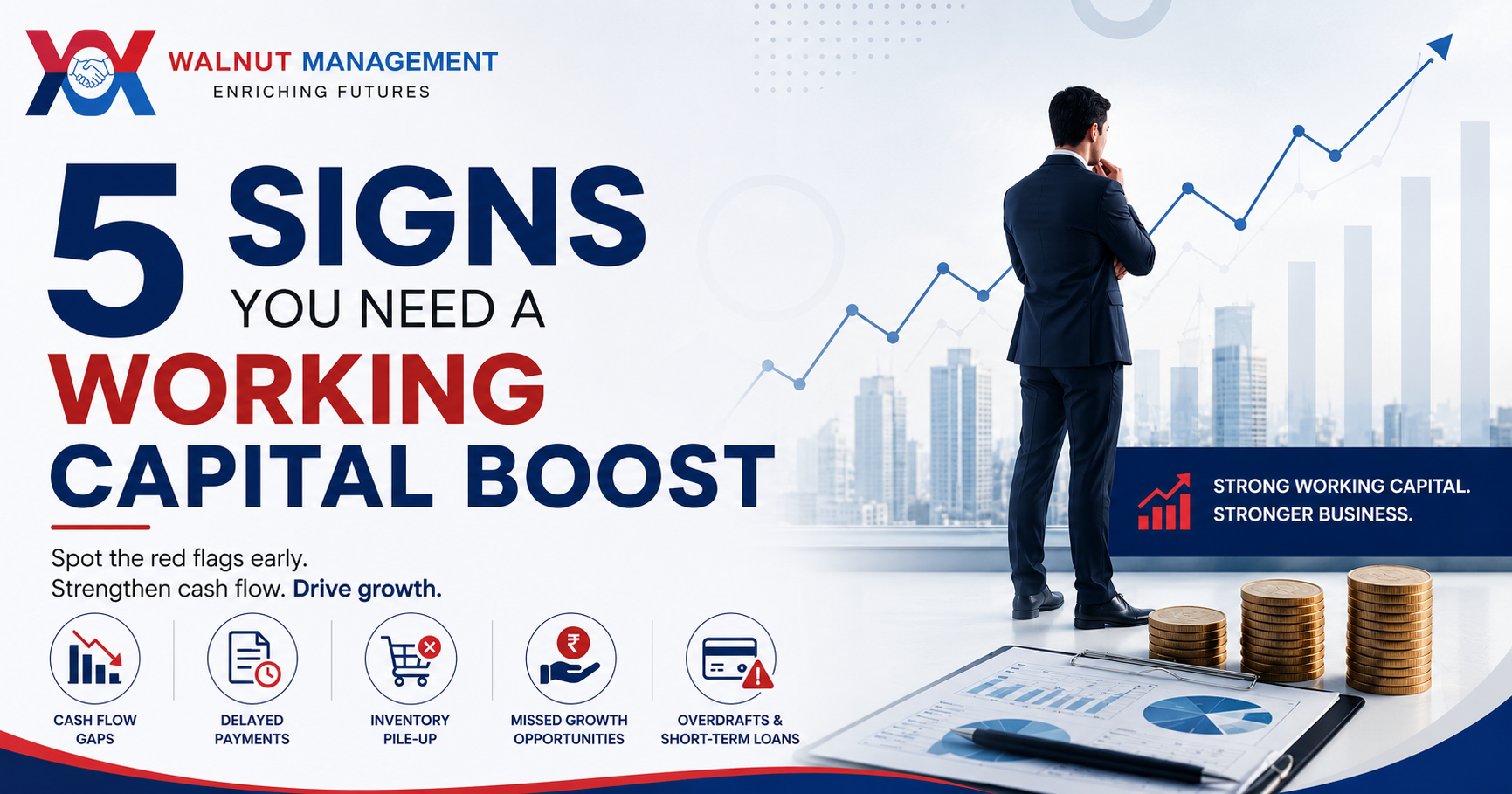
If you find yourself asking suppliers for a few extra days almost every month, that's not a supplier relationship issue — it's a working capital gap. Occasional delays happen to everyone, but a pattern of late payments usually means your cash inflow cycle is slower than your cash outflow cycle. Left unaddressed, this can damage supplier trust and even affect your credit terms and business reputation.
Sign 2:
Your Sales Are Growing But Your Bank Balance Isn't:-
This is the classic paradox of a scaling business. Revenue on the P&L is rising, but the current account is thinner than ever. It usually happens because growth ties up more money in inventory and receivables before that money comes back as collections. Without a matching increase in your working capital limit, growth itself becomes the thing that starves your cash flow.
Sign 3:
You're Relying on Personal Funds or High-Cost Informal Loans:-
Dipping into personal savings, credit cards, or informal lenders to cover business gaps is one of the strongest signals that formal working capital is missing from your structure. Informal credit is expensive and unsustainable, and it blurs the line between personal and business finances — something banks and future investors will scrutinise closely. A properly structured CC or OD limit is almost always the cheaper, more sustainable route.
Sign 4:
Your Inventory or Receivables Cycle Has Stretched Longer Than Usual:-
If stock is sitting longer before it sells, or customers are taking longer to pay than they used to, your operating cycle has lengthened — and a longer operating cycle needs more working capital to fund it. Many business owners notice the symptom (cash shortage) without connecting it to the root cause (a stretched cycle). Tracking your receivable days and inventory days regularly can catch this early.
Sign 5:
You're Turning Away or Delaying New Orders:-
This is the most costly sign of all — saying no to business because you don't have the cash to procure raw material or fulfil the order. When cash constraints start dictating which orders you accept, the working capital gap is no longer a background issue; it's actively capping your revenue and your growth ceiling.
What Happens If You Ignore These Signs ?
A persistent working capital shortage rarely stays stable — it tends to compound. Delayed supplier payments affect your credit terms, stretched cycles increase interest costs on informal borrowing, and missed orders mean lost market share to competitors who can fulfil demand. The earlier a working capital gap is addressed with a proper bank facility, the less it costs the business in the long run.
How to Fix a Working Capital Shortage the Right Way:-
The right fix depends on your business model, operating cycle, and banking relationship. The three most common structured solutions are:
- Cash Credit (CC) Limit
A revolving limit against stock and receivables (hypothecation), allowing you to draw funds up to a sanctioned limit and pay interest only on the amount used. Ideal for trading and manufacturing businesses with regular inventory cycles. - Overdraft (OD) Facility
A flexible limit typically secured against property or fixed deposits, well suited for businesses that need quick, short-term liquidity without a fixed repayment schedule. - Working Capital Loan
A structured loan to permanently shore up the working capital gap identified in your CMA data — often used alongside a CC/OD limit rather than instead of it.
Each of these requires accurate CMA data, a realistic projection, and a proposal that speaks the bank's language — which is where most SME applications either get delayed or under-sanctioned.
How Banking CFO Helps You Secure the Right Working Capital Limit ?
As a Shared Banking CFO for SMEs across Delhi NCR, we prepare bank-ready CMA data and project financing, identify whether a CC, OD, or Term Loan structure fits your operating cycle, and liaise directly with banks to get limits sanctioned or enhanced — so you're not navigating bank documentation and follow-ups on your own while trying to run the business.
If two or more of the signs above sound familiar, it's worth getting your working capital position reviewed before it turns into a cash crisis. Connect with the Banking CFO team for a free assessment of your current banking limits and working capital structure.
Frequently Asked Questions:-
Q1. How much working capital does my business actually need?
It depends on your operating cycle — how long cash stays tied up in inventory and receivables before converting back to cash. A proper CMA data analysis calculates this precisely rather than estimating it.
Q2. What is the difference between a Cash Credit limit and an Overdraft?
CC is typically secured against stock and book debts and is used for regular trading/inventory cycles, while OD is usually secured against property or fixed deposits and offers more general-purpose flexibility.
Q3. How long does it take to get a working capital limit sanctioned?
With complete documentation and accurate CMA data, most banks process working capital proposals within a few weeks, though timelines vary by bank and limit size.
Q4. Can a new business apply for a working capital loan?
Yes, though newer businesses may need to lean more on collateral, projected financials, and schemes like CGTMSE for collateral-free options.
Q5. What documents are required for a working capital limit?
Typically CMA data, financial statements, GST returns, bank statements, and KYC documents — the exact list depends on the bank and limit type.
Reviewed by the Banking CFO Team — banking advisory and loan facilitation specialists working with SMEs across Delhi NCR (New Delhi & Faridabad), with direct experience structuring CC, OD, and Term Loan proposals for scheduled banks and NBFCs.
.